
Let's give them Something Else! to talk about
A slightly spicy interview with the artistic director of Hamilton, Ont.'s annual creative-music festival
This very day, the annual Something Else! jazz/improv/new-music festival in Hamilton begins—first up is a free “Two Pianos, No Rodeo,” show by the Rock Bobster himself, Bob Wiseman (once upon a time keyboardist of Blue Rodeo), and Mike Boguski (current keyboardist of Blue Rodeo) at 5 pm at the public library.
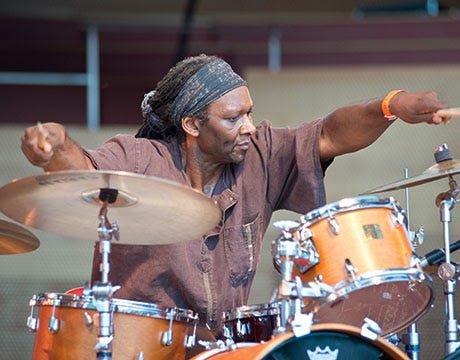
Proceedings continue through Saturday with a busy roster, headlined to my way of thinking by Chicago’s Hamid Drake, one of the world’s greatest living percussionists, in several ensembles including the current iteration of New York saxophonist Avram Fefer’s Juba Lee quartet (Thursday and Friday), a trio with Vancouver/Melbourne cellist Peggy Lee plus Toronto’s Brodie West (Friday), and a duo with Fefer (Saturday). Which is just to scratch the surface.
I notice that this year’s program showcases a smaller set of players than previous years, in a wider range of configurations, though still from both near and far. Curiosity about that is part of why I approached festival artistic director Cem Zafir for the second of my June festival curators’ interviews. His answers do get spicy in places.
A Q&A with Cem Zafir
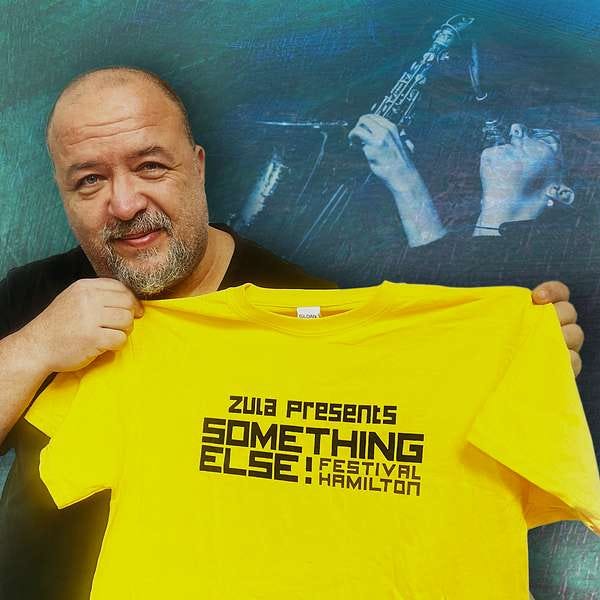
Cem Zafir came from Turkey to Ontario in 1983, at age 16. In his early 20s, he moved to Vancouver, where he volunteered with the Vancouver/Coastal Jazz festival through the 1990s before putting on his first independent show as Zula Presents there with John Zorn’s Masada circa 2000—not too shabby a start! In 2012, Zafir “landed,” as he puts it, in the mid-sized working-class city Hamilton, Ont. (about an hour-plus from Toronto), and started putting on creative-music shows there in 2014, including the first weekend-long Something Else! festival.
(This interview was conducted by email; it’s been edited for length and clarity.)
To start, could you mention a few shows in the history of the festival that are particularly memorable for you?
I get teary-eyed about many of our past events. Off the top of my head—the first visiting artists in 2014, Boneshaker with Kent Kessler, Paal Nilssen-Love, and the dear, sadly departed Mars Williams. Beauty, simplicity, elegance. Or Ken Vandermark subbing in for a stranded-at-Heathrow Mats Gustafsson for The Thing gig in 2016: Ken jumped on a flight that very day, after I woke him up that morning. Great, fun night!
In 2019: Hamid Drake with Iva Bittova, a very special duet situation, then Don Byron with Indigenous Mind with Hamid Drake, Jason Adasiewicz, and Josh Abrams—wow!
Our resilience during the pandemic felt very much like what a community of people should do in these instances. We had François Houle stopping by on his brave tour across Canada. We had the performance in our backyard with 10 people, the maximum allowed. Lovely.
Every year there are at least a few things that blow me away. Last year’s standout for me was Anna Webber’s Simple Trio with John Hollenbeck & Matt Mitchell. A working band that’s been at it for over a decade with beautiful writing, telepathic interplay, chops, soul . . . I’d love them back.
What are the challenges specific to doing this festival in Hamilton, rather than a place with a more established jazz/new-music scene like Toronto, and what are the benefits?
For the most part, an uninitiated audience. When we first moved here, we were encouraged by many to move forward with a new festival, as there were to be many folks hungry for creative music. As it turns out, even the majority of the arts people in exodus from Toronto and other places, who now call Hamilton home, do not have a penchant for more adventurous forms of music.
The upside is, ever so slowly, the audience is becoming more enthusiastic and expanding bit by bit, as some folks start to get the idea that this is not some kind of a zeitgeist novelty thing, or vanity project, or highbrow cultural activity meant only for a select few. The art form we’re focused on is a living, breathing organism with many participants bringing their freshest ideas and connecting with other players and audiences, while changing along with it, as it’s continuously evolving, expanding, developing.
Yes, it’s quite difficult to make the numbers work with smaller audiences, but the new community built and the positive effects visible on their faces and the palpable energy present are reasons to keep going.
There are so many competing festivals this time of year. Why this timing?
Festivals who tend to present similar artists we’re interested in bringing to Hamilton from elsewhere, like Suoni per il Popolo in Montreal, Vision in New York, and the Ottawa and Vancouver jazz festivals, all convene around this time [which helps artists organize their tours], and are all far away enough for there to be no conflict in splitting nearby audiences. As mentioned below, this could change next year.
What about the overlap with more local festivals like TONE and Toronto Jazz?
Total transparency: It’s complicated. It’s not as simple as the best outcome being as many gigs at as many stops as possible for touring bands, musicians, artists. During the year this is not an issue, but for the festival to survive and thrive, we need to see a healthy number of attendees from all across Southern Ontario.
We’ve encouraged artists to make multiple stops in certain cases during the festival (and always, without reservation, for year-round shows), but only when it made the artists’ tours viable, shared expenses for travel and with communication among presenters to make it all work, not door gigs with zero support for travel, which then translate into lost audiences for us, despite our efforts in doing the heavy lifting. I’m not greedy—I’m talking about dozens of people, not hundreds.
By some I’m seen as being competitive for raising my voice. But my partner Donna and I have put our personal future at risk to keep the festival going. By 2022, we could’ve, maybe should’ve folded. So it’s natural to be concerned about fairness and equal distribution of risk.
We certainly present a huge number of Toronto artists as well. We consider them locals. Yet there’s a weird Toronto-as-centre-of-the-universe vibe at times from certain people. It’s not all about the presenters. There are many writers, super-fans, industry people, etc., who have not set foot in any of our events yet, in our 13 years. People will travel to Victoriaville or Guelph (and they certainly should) but not to Hamilton. Maybe we’re scary?
Last year I noticed some audience members coming from well out of the area, even the country. How common is that, and have you done outreach specifically to encourage it?
The first time we had the opportunity to present a really full, thoroughly well-balanced program close to our vision was in 2017, with many visiting artists. We had a healthy number of out-of-towners visiting us from Ohio, Michigan, Indiana, Texas, New York, Illinois, Quebec, from all over Ontario, including Ottawa, etc. . . . Last year it happened again. We hope to get a similar crew of road warriors this year. We have put out ads and distributed flyers at Victo, and at Vision in the past.
What’s the organizational structure behind Something Else! and your other shows?
Zula Presents ran as an ad hoc group until Zula Music & Arts Collective Hamilton was established and incorporated as a not-for-profit in May, 2019, as overseer of and umbrella organization over the festival and the series. We used to have a large group of board members and collective members. This proved to be untenable. Now the board consists of four to five people. The collective is made up of the regular folks who have a hand in all the operations. Other than the artists we have very few contractors, except a few specialists in their fields, like sound and tech.
What are your sources of funding? What are the hoops you have to jump through?
It’s been challenging and at times limiting. At the moment, we can rely annually on the City of Hamilton’s City Enrichment Fund and the Department of Canadian Heritage’s Canada Arts Presentation Fund. Beyond that, every three to four years we may succeed with Canada Council or Ontario Arts Council. In another city the same presentations could be double the admission, so we tend to lose on that as a potential for increased source of income.
We make so much happen with so little. But all told, we feel fortunate that we can put out something of value each and every year. My choice would be 100 per cent self-sustaining, a very rare thing in the world we have, sadly. I’d love to work on a similar scale to the worker owned co-ops in Mondragon, in the Basque region of Spain. Maybe have various side industries with a flat hierarchical structure to help keep the arts alive. That’s only a fantasy, but one that gets me excited, having studied such progressive, more egalitarian models in school.
I notice this year has artists much more doubling, tripling, quadrupling up on shows over the weekend. I assume that’s an outcome of the factors you discuss above. But is there a positive aspect to it too?
Sure, limited budget, but we still have a handful of visiting groups and artists. We try to give visiting artists extra plays to make up for their high travel expenses, exchange rates, etc., trying to make their tours viable. It’s also very satisfying to experience weekend runs like the old days, when you get to observe artists settle in a bit and give multiple perspectives on their work, as well as solo and ad hoc takes on where they’re at.
We don’t pay anyone big fees. We try to distribute our meagre budget as fairly and equally as possible.
How have your artistic interests changed over the years as a listener and as a presenter?
I’m nowhere near as up to date, knowledgeable or even curious as some of our audience members, probably. We receive many submissions and all I have is my instincts to get out of the way of what looks like should happen. As an organization, when we first started in Hamilton, we didn’t want to step on any toes, so we stayed away from presenting other genres and disciplines. Many local organizations specializing in straight jazz, world, electronica, etc. have either ceased to exist, sadly, or have slowed down significantly. So, we tend to present a wider range than when we started. The year’s programming is pretty much our old wheelhouse, as it turned out.
How do you feel about the state of creative jazz/experimental music/etc in 2026, especially in Canada but also in general? What are you gladdest to see happening and what causes you the most concern?
Limited media interest and coverage, lack of appropriate venues and infrastructure, limited funding, especially for work of great value and depth, audience attention evaporating—with too many screens and platforms, dwindling interest in live performance, perhaps. Yet there’s still lots happening.
One thing that never changes is that those artists who are deeply passionate about the music and are resilient enough will keep at it no matter what, against all odds. This is not recommended to all younger artists. There’s a serious cost. It can have a negative effect on one’s personal life. Artists should not have to give up on other aspects of their lives to pursue a life in music.
There are many who keep touring and writing and playing in different settings and with other players locally, regionally, and from around the globe, making new work that begets new ideas and on and on it goes, keeping it fresh, exciting and evolving without any end in sight. This is truly inspiring.
What do you see for the future of Something Else?
Many possibilities being entertained. We could stop doing it altogether anytime. It’s hard and I’m at times feeling burned out and depressed about it.
We could also double down and split the festival into two parts: In spring, add a new component—more straight jazz, world traditions, pop, and electronica outdoors—and in the fall, our indoor SE! Fest. Or we could just move the festival to the fall partly to make the funding work better. We could run our own year-round venue, which has been a dream for years and the city really needs a multi-faceted, well-curated community hub, a laboratory that’s welcoming, to both encourage new works and to keep the wheels turning. We could also keep going at a similar clip with little change. We’ll see.
Anything else you’d like to add about this year’s festival?
What we try to do is about community, sharing, being, connecting—a joyful endeavour. Not about egos or high culture, more about being present and listening, connecting and growing, being moved and also entertained. It’s important for us that anyone with curious ears and minds feels welcome. Our admission policy is, “No one is refused admission for lack of funds.” But we appreciate folks who can afford to pay to do the right thing and contribute, as it’s still a struggle to keep going in a balanced and dignified fashion.
Come, check out some incredible, original, moving, in the moment music-making by some of the world’s greatest artists in jazz, creative and improvised music, without even leaving town—or a short drive, train, bus ride away!
The day, eve and festival passes are such fantastic value! And here’s a tip … you can certainly order via Eventbrite and secure your admission tickets and passes, but if you’re comfortable with sending an e-transfer to tix@zulapresents.org for advance ticket and pass purchases, you save a bunch, as then we charge no service fees for these direct payments.
To stay informed via our handful a year newsletters, people may want to get on our mailing list (and volunteer list if they desire) by emailing us at info@zulapresents.org.
Love Hamid! Avram's Juba Lee Quartet smokes - see it if you can.