
'This machine is killing me'
Phoebe Bridgers contemplates men, music, and aging in her "Lost Boys" TV performances
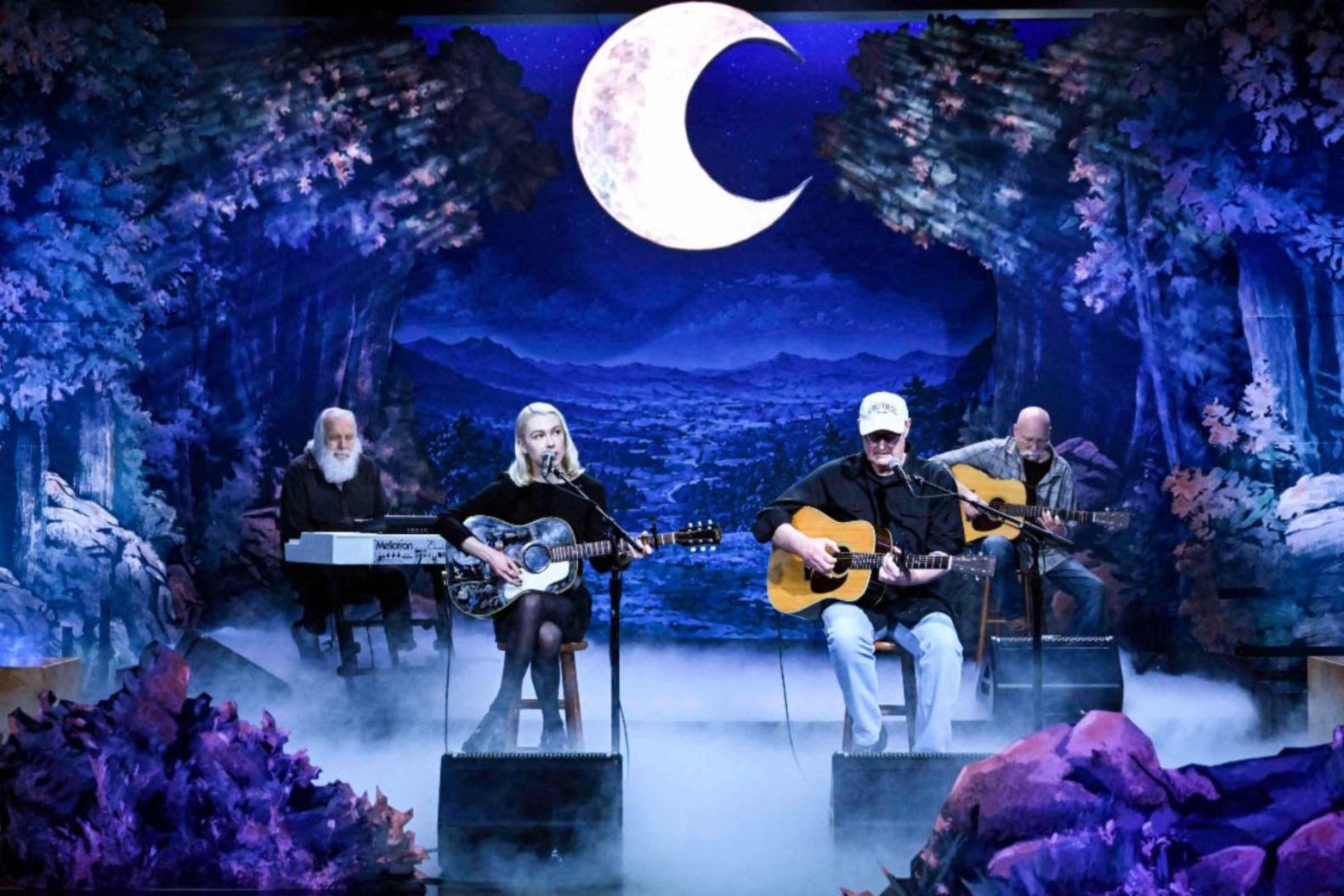
The World Cup is over and suddenly I find myself able to think about other things again.1 Tonight I was thinking about the two versions of “Lost Boys” that Phoebe Bridgers performed on The Tonight Show last week—one electric, with a backing band of child performers, and the other acoustic, with a group of old men.
I’ve seen a range of reactions to the two performances, but the majority have appreciated the pair as typically smart, funny manoeuvres from Bridgers, akin to her smashing her guitar on Saturday Night Live. Most don’t seem to have found them as emotionally touching as I did. My reasons are both about Bridgers’ passageways and the song itself.
I’ve had a low-bubbling anxiety for months about the upcoming Bridgers album Lost Weekend, which is coming out on August 14. It’s the first solo Bridgers album in six years. Her second full-length, Punisher, came out in June of 2020 and has remained maybe my personal favourite album of the decade ever since. During that first year of the pandemic I often found that hers was the only music I wanted to listen to. The surface fragility had both a hidden steel and an undercurrent of existential comedy that I found sustaining.
So this next album carries the weight of too much expectation for me, especially because I found a few of Bridgers’ parts of the Boygenius album The Record weaker by her own standards and compared to her bandmates’ contributions.
In the meanwhile, partly because lots of other people felt like I did about Punisher, partly thanks to a set of shows opening for Taylor Swift on the Eras tour, and partly because of people she dated, Bridgers became way more famous than I was expecting. Celebrity-gossip-websites-and-Met-Gala famous, the kind of crossover that upsets the equilibrium of easy indie-community affinity. She may be the strongest stylistic successor to Elliott Smith, but Bridgers often seems ready and willing to take those steps, compared with how out-of-place Smith seemed alongside showbiz figures like Madonna and Céline Dion at the Oscars in 1998, a story with which I opened my Let’s Talk About Love book. My point then of course was to deconstruct those pop-versus-art reflexes. But I can’t claim to be fully liberated from them. So that brought on an extra wariness.

Still, the coming of Bridgers’ surprise pop-up preview tour in the early summer was exciting and reassuring, with its airs of secrecy (no phones or even notebooks allowed) and reports of strong new songs. Then when “Lost Boys” was released as the first single, I was distracted by the Ren-faire/Lord of the Rings/fantasy-video-game cosplay stuff in the video, which really ain’t my thing, and also by adjusting to a solo Bridgers song with a conventional chorus, which usually isn’t hers. Listening without the visuals, I began to love the song … but then it was late June and, as I said, the World Cup was on.
The novelty TV performances this week pulled me back in. Bridgers usually makes the most of such moments, never turning in a rote appearance, always coming up with a performative twist. The concepts here pulled me deeper into the heart of the song.
Its title phrase obviously evokes all the cultural (and famously androgynous) and self-help-book baggage of the Peter Pan story. So yes, it’s a song about persistent miscreant strains of masculine immaturity and how Bridgers navigates and copes with them as a woman attracted and attached to men (albeit not exclusively). Bridgers also likes to nudge and flip gender roles, often joking about what kind of “guy” she is, and with her all-woman trio being dubbed Boygenius. So I doubt she entirely exempts herself from being a lost boy too.
But the song also has a deeper cross-generational scope. While she’s been out of the public eye, Bridgers has been dealing with the death of her father. In the past she acknowledged their difficult relationship in interviews and in songs, especially the standout Punisher track “Kyoto.” For better or worse, fans also know Bridgers has had complicated romantic involvements with older male musicians. And finally, Bridgers’ recent and perhaps still current beau, the comedian-musician Bo Burnham, is credited as one of the co-writers on this song.
It’s hard not to hear all that in the verses of “Lost Boys”: In the first, a story about a risk-taking motorcycle rider who goes into military service (“your rifle and your papers”) probably in a decade fairly long past (“another life / where they make you cut your hair”). In the second, somebody who “in East Berlin … threw a tantrum with a 57 / and broke a rib.” Like other listeners, due to the previous verse and the “East Berlin” bit, I took it as a .57 gun at first, but Bridgers clarified with an Instagram post that it’s an SM57 microphone, a pro standard. And then in the final verse, she’s with someone “in a twin bed / where all will be forgiven in an instant,” but then “in the morning / you were not there.” It seems to be a through-the-eras montage of flawed fathers, mentors, lovers.
As in the key “Kyoto” line, “I don’t forgive you / But please don’t hold me to it,” Bridgers expresses her ambivalence sharply-tenderly here: “I don’t feel bad / But I’m sorry.” I hear that kind of sentiment again in the chorus, which has a country-rock lilt that makes it feel just a tick or two outside of contemporary musical fashion. It ends on the line, “Lost boys / Find me,” which reads two ways: both, “Why do these wayward boy-men always seem to make their way to me?” and, “Come to me, I want to be what gets you unlost.”
The Tonight Show performances clearly underline the generational theme, placing Bridgers, a few weeks from turning 32, in between two more vulnerable cohorts. The child-teen performers bring back the image of Bridgers as one of them in the 2010s, a precocious performing-arts high-school kid at open mics and in teen bands in L.A. She probably wishes there weren’t so much publicly available documentation. Here she is, for instance, playing her song “Waiting Room” at 17, her style already edging into view.
When Punisher came out, she was 25 and still relatively little-known, not so drastically removed from those days. Today they must seem very far away. It feels poignant and generous for her to share the stage with this succeeding wave of prodigies, as she sings about never growing up, never getting old.
On both broadcasts, Bridgers selects her accompanists carefully. To most viewers they would seem like random representatives of their age groups. But on closer investigation they turn out to be forces in their own rights: I was tipped off by a bassist friend that the young’un holding down the bottom end on night one is a 13-year-old YouTuber called EllenPlaysBass, who has more than 700,000 subscribers. The others likewise turn out to be up-and-comers with heavy-duty musical co-signs. There’s more to a lost boy or girl than meets the eye.
On the pre-chorus of “Lost Boys,” Bridgers sings, “This machine is killing me,” a line that nods to the storied inscription on Woody Guthrie’s guitar, “This machine kills fascists.” You might take it as a line about fame, Joni Mitchell’s “star-maker machinery.” But I take it here as more to do with aging and mortality, with Bridgers recognizing that she’s cast in her lot as a lifer in music, wedded to that guitar, which she’s now fated to carry till the end. Maybe it is about the grinding, mulching mechanisms of the patriarchy too. Perhaps it even asks, “Wait, what if I’m the fascist here—or at least the asshole?”
And so on night two she is joined by a trio of greybeards, the could-be villains becoming maybe allies. The guitarist singing harmony with her is Dan Reeder, a disciple of John Prine’s who has gained a much-expanded cult following in the 2020s, as he’s entered his 70s. (Speaking of cross-generational projects, his 2026 live album with his daughter Peggy Reeder is definitely a place to start.) The bald guy in the background is David Grier, a three-time bluegrass-association guitarist of the year and guitar hero to many including the spectacular Molly Tuttle (who’s roughly Bridgers’ age). And on keyboard it’s J.T. Thomas, a longtime sideman to Bruce Hornsby who’s also played with Tracy Chapman, Bonnie Raitt, and Jackson Browne, but perhaps most notably for many of my readers, got his start as a member of Captain Beefheart’s Magic Band.
Between the two clips, it’s as if Bridgers has flanked herself with the ghosts of musical life past and future, while reserving the present for herself (in her prime, with a record to promote). If anyone has the profile of a Peter Pan sidekick, after all, it’s the archetypal musician, never going straight, never settling down. That’s Bridgers’ steady self-awareness, her weave of meaning always boring down and deep, past the iceberg’s visible peak to its archaic Arctic core. “I pretended it was make-believe,” she sings. Whether in family, love, or music, you can play all the tricks, make all the evasive manoeuvres you want, but with each passing year you learn and re-learn that what’s gone by is never truly over. Every encounter leaves its mark, the game is always for keeps. So you’d better leave it all out on the pitch. Go ahead: find me.
The outcome was what I wanted from the start—a Spain victory!—but not in a way anybody wanted, with a pissy Argentina giving such a shoddy show in the final. Only goalkeeper Emiliano Martinez and some dubious officiant calls prevented what might have been about a 5-0 score instead of 1-0. And ideally Lionel Messi would have gotten to score at least one, too, in his likely final Cup match, but Spain’s gameplan clearly involved keeping him almost entirely off the ball. Still: OLÉ OLÉ OLÉ!!!
I was struck by both performances. Also glad I watched the official video afterwards. I wrote about in my Fridays Faves from last Friday. Link in my bio